Travellingvisio.com
Loch Ness: Travel tips, secrets, and the beauty of Scotland's most famous lake

 Scotland
Planning a trip to Loch Ness in Scotland? Check out my tips — you'll enjoy a boat cruise, Urquhart Castle, waterfalls, Fort Augustus and the mysterious Nessie!
 New: Follow me on WhatsApp channel 🤟
Loch Ness is a famous loch in the Scottish Highlands, best known for the legend of the monster Nessie. At over 37 kilometres long and up to 230 metres deep, it’s one of the largest and deepest lakes in Britain. Surrounded by beautiful Scottish countryside, Loch Ness attracts visitors not only because of the mystery that surrounds it but also for its historic sites, such as Urquhart Castle, which towers above the water. It’s a place full of history, legend and breathtaking scenery that draws visitors from around the world.
History of Loch Ness
Loch Ness has a fascinating history that stretches back to the Bronze Age. It’s known not only for the legends about Nessie but also for its role in Scotland’s history. Over the centuries the loch was an important waterway and played a key part in trade. In the 13th century several castles were built around the loch, including the famous Urquhart Castle, which witnessed many historic events, including conflicts between the Scots and the English. Loch Ness became known worldwide partly because of modern interest in the Nessie mystery, attracting millions of visitors each year. The history of this loch is as rich as it is mysterious.
Research at Loch Ness
Research on Loch Ness dates back to the 19th century, when the first underwater expeditions began exploring its depths. Research gained the most attention in the 20th century, especially after 1934, when the famous photograph known as “Dr. Wilson’s Photograph” was taken and allegedly showed the creature Nessie. In the 1960s modern techniques such as sonar were used for the first time to investigate the deep waters of Loch Ness. Underwater structures of the loch were mapped during these expeditions, but no evidence of a large aquatic creature was found. Scientists such as Dr. Neil Gemmell conducted a study in 2018 using environmental DNA analysis to try to detect traces of animals that might be linked to the Nessie legend. That research also did not produce any concrete evidence of the monster’s existence.
When it comes to modern research, in recent years more advanced technologies have been used, including drones, underwater cameras and highly sensitive sonars that help scientists map the loch bed and track animal movements in its waters. In 2019 a sonar survey covering the entire loch was carried out to check for any unknown aquatic creature. While some experiments produced interesting results in the form of unusual sonar returns, none of these studies has yet proved the existence of a giant aquatic animal. Instead, most scientists attribute strange sightings and sonar echoes to optical illusions or known species. Research continues, but the mystery of Loch Ness still attracts not only scientists but also tourists hoping to catch a glimpse of the legendary Nessie with their own eyes.
Boat cruises on Loch Ness
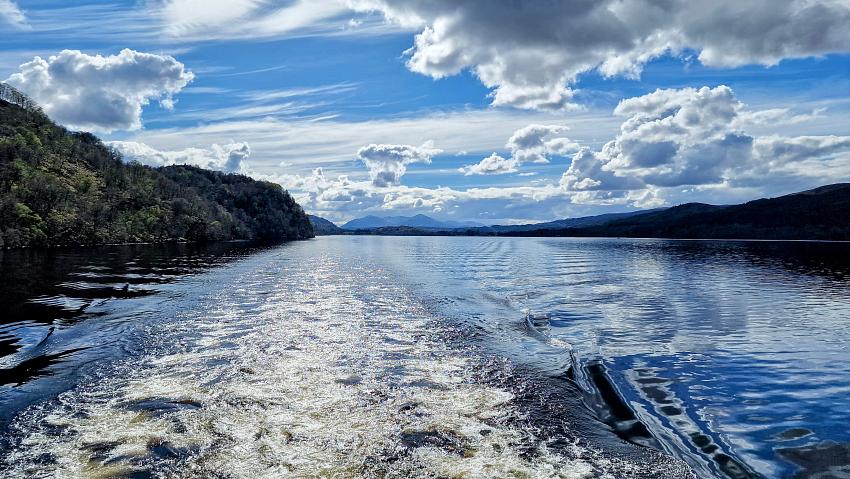
If you visit Loch Ness you can book a boat cruise. I recommend arriving early in the morning or joining the queue as soon as possible. The boat fills up very quickly.
During the cruise they’ll tell you about the loch and show you images from the sonar.
More information can be found on the website Cruise Loch Ness.
What to see around the loch
My visit to the loch was fairly short. If you have more time, I recommend planning trips around the loch:
-
Urquhart Castle – An iconic ruin overlooking Loch Ness. It offers not only stunning views but also an engaging exhibition about the castle’s history and the surrounding area.
-
Loch Ness Centre & Exhibition (Drumnadrochit) – An interactive centre where you can learn all about the Loch Ness monster, the loch’s history and the scientific research. Great for families and curious adventurers.
-
Falls of Foyers – A beautiful waterfall on the loch’s southern shore that even inspired the poet Robert Burns. The area is ideal for an easy nature walk.
-
Fort Augustus – A picturesque village at the southern end of the loch with a cascade of locks on the Caledonian Canal. A great place to relax, have a coffee and watch the boats.
-
Inverness – the capital of the Scottish Highlands, just a short distance from the loch’s northern tip. It offers historic attractions, shopping and access to the region’s culture.